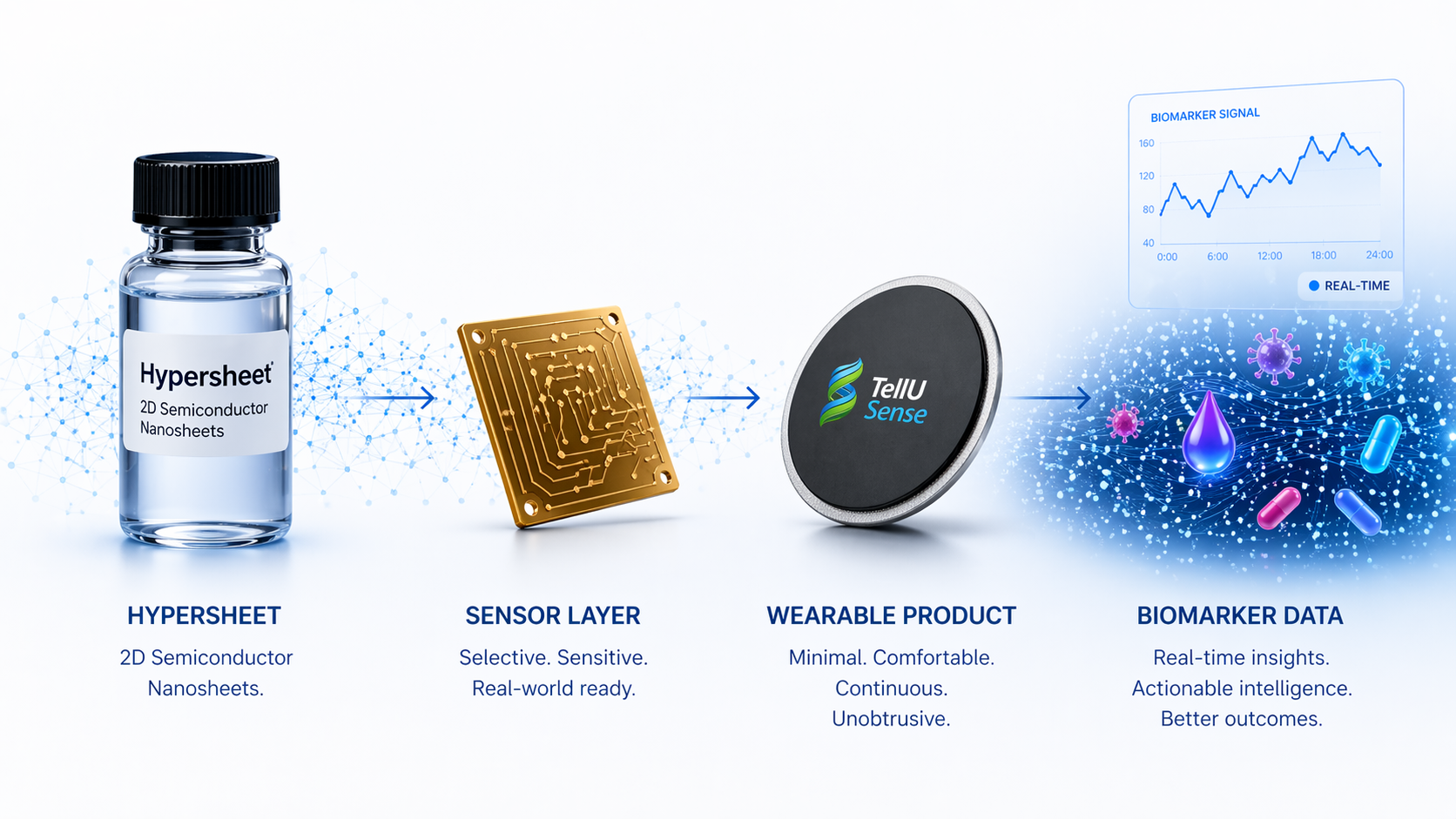
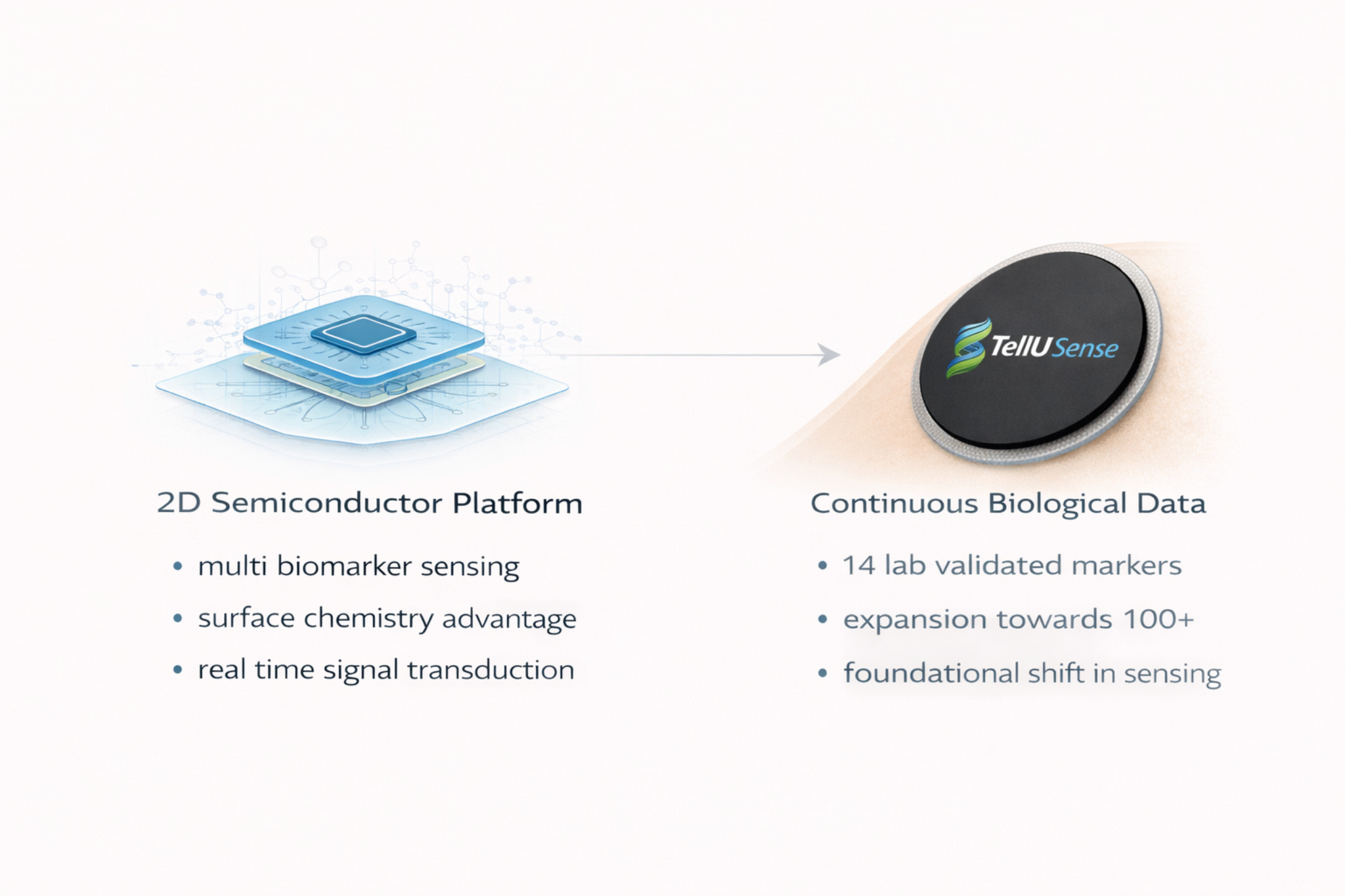
Nano Performance Technologies is a Purdue-derived 2D semiconductor platform enabling scalable multi biomarker detection without redesign at each new target. The platform supports 14 validated biomarkers today and is expanding toward a 100+ marker library, unlocking continuous biological data from a single system, built from millions in non dilutive funding and validated research.
Biosensing is shifting from single analyte systems to semiconductor based multi biomarker platforms.
Platforms that scale across biomarkers without redesign win. NPT is that platform.
Biosensing has been locked into narrow, single-target architectures for decades. Every new biomarker required years of development and significant capital. That era is ending.
Existing biosensor companies are constrained to single-target sensing systems — like glucose monitors — that must be entirely rebuilt for each new biological target. Expanding has historically required multi-year development cycles and capital-intensive redesigns. There is no path to platform scale from these architectures.
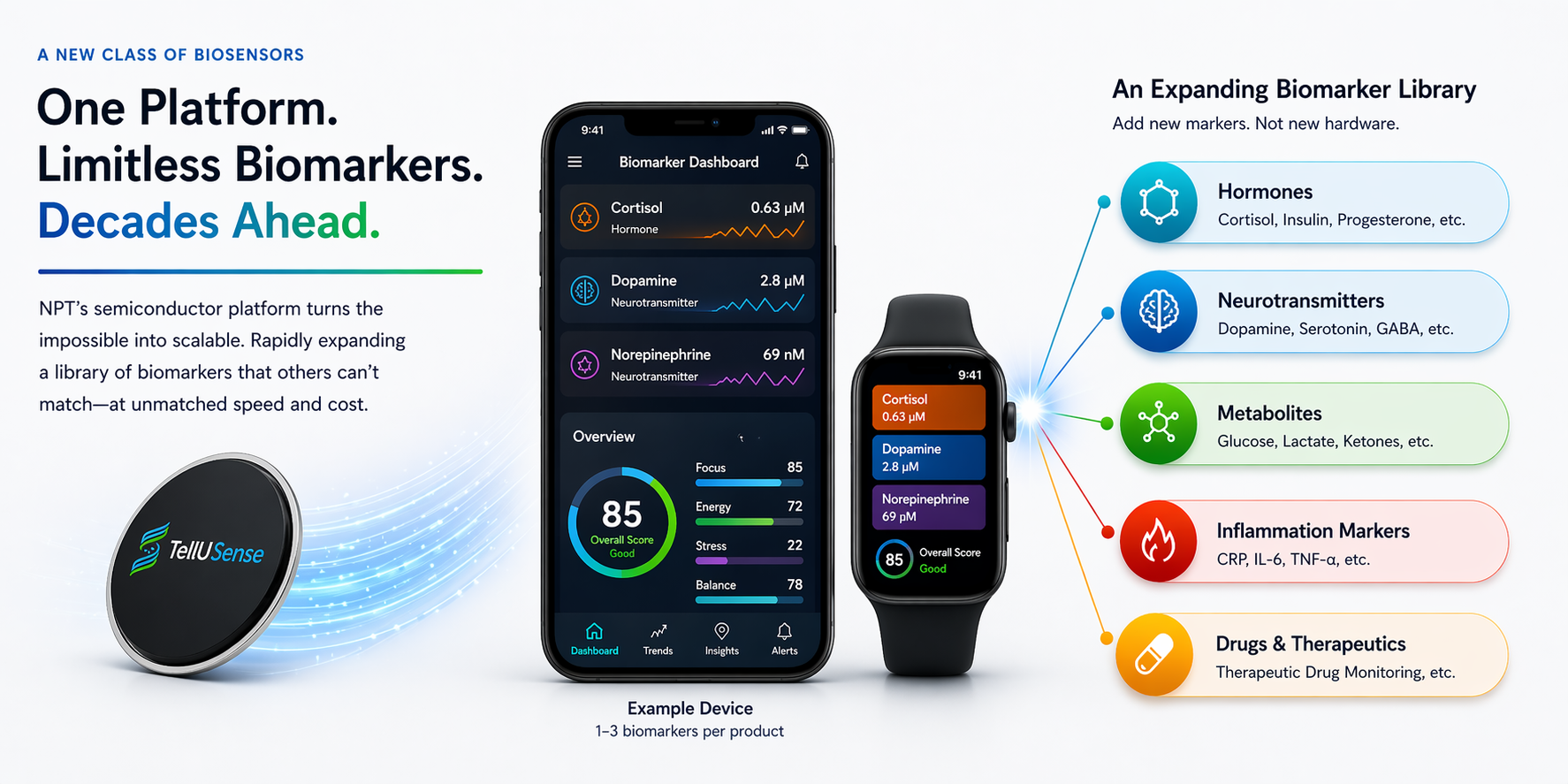
NPT's 2D semiconductor platform supports 14 validated biomarkers today — and the library expands without requiring device-level redesign. Each new biomarker adds to the same foundation. The same architecture that detects neurotransmitters in sweat today will power clinical-grade microneedle devices, licensing deals, and AI data infrastructure tomorrow. NPT's semiconductor materials introduce unique surface chemistry, enabling biological signal transduction with levels of sensitivity and reliability not achievable through conventional sensing approaches.
The TellU Sense device is the first commercial expression of the NPT platform — a wearable biosensor that reads multiple biological signals in real time through sweat, with a clear pathway to FDA-grade microneedle devices.
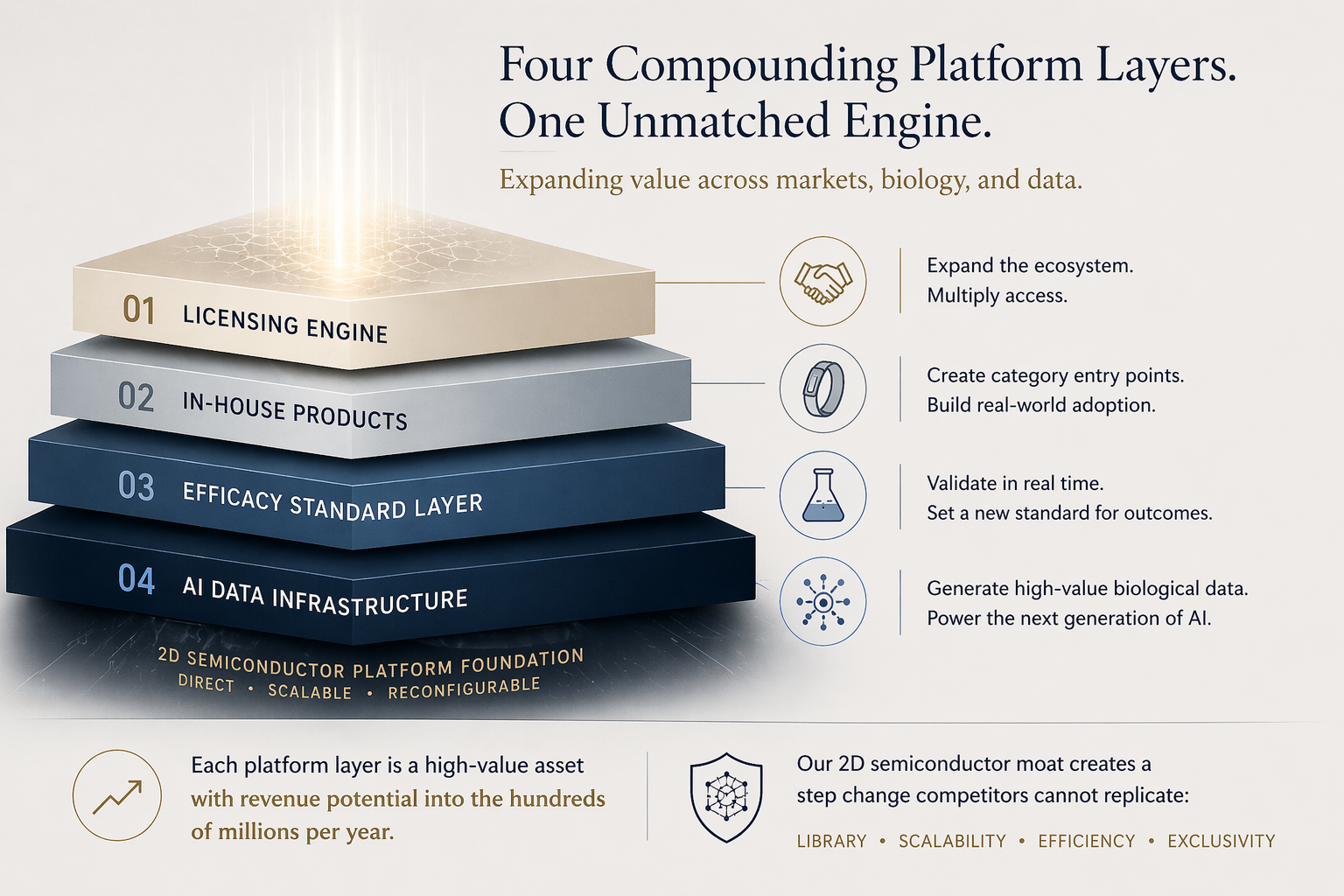
This is not a single-product company. Each layer reinforces the others — creating a platform business that compounds as the biomarker library grows.
Biomarker capabilities and platform access licensed to wearables, diagnostics, and biosensor companies. Structured deals target the $50M–$500M range as the library expands.
PrimaryTellU Sense wearable systems — sweat-based market entry (non-FDA) with FDA microneedle optionality extending into clinical-grade devices.
Near-termReal-time biological validation for pharmaceuticals and nutraceuticals. Positioned to become a new industry standard for efficacy measurement.
EmergingLive human biological data at scale — high-value datasets for AI models that cannot rely on synthetic data. A new category of data asset.
Long-termTechnology validated through funded research, lab testing, and early human trials.
Demonstrated multi-neurotransmitter detection in human subjects — a milestone no competitor has reached with a scalable architecture.
Lab-validated across a growing biomarker library, each supported by the same underlying semiconductor architecture.
Over $4M in non-dilutive funding from USAF, DoD, DOE, and NSF has de-risked the core technology. We are not funding discovery — we are funding execution.
In active discussions with multiple corporate development groups across semiconductor and medtech, many of whom have expressed interest in leading a future Series A.
The biosensing market has seen $10M–$300M+ rounds for companies with fewer validated biomarkers, no scalable platform, and no underlying semiconductor IP. NPT enters at a fraction of that cost basis.
| Company | Architecture | Biomarkers | Scalable Platform | Semiconductor IP | Revenue Status | Capital Raised |
|---|---|---|---|---|---|---|
| NPT (us) | 2D Semiconductor | 14 validated | ✓ | ✓ | Pre-revenue | $1.5M (raising) |
| Typical Biosensor Co. | Biorecognition-limited | 1–3 | — | — | Pre-revenue | $10M–$100M+ |
| Wearable Biosensor Co. | Single-analyte | 1 | — | — | Pre-revenue | $50M–$300M+ |
| Diagnostics Platform | Enzyme-coupled electrochemical | 3–5 | Partial | — | Early revenue | $30M–$150M+ |
This round funds execution, not discovery. Investors are entering at the earliest commercialization inflection — before revenue visibility, before licensing scale, before product launch.
Comparable companies have raised $10M–$300M+ at equivalent or later stages with fewer biomarkers, no scalable platform, and no underlying semiconductor IP — while remaining pre-revenue. NPT enters at a fraction of that cost basis.
This round is designed to unlock a significant re-pricing event, positioning the company for a Series A in the $75M–$300M range.
Investors are entering before: revenue visibility — licensing scale — product launch. This is one of the last entry points before commercial launch and the associated valuation re-pricing.
Already in discussions with multiple corporate VC and corporate development groups across semiconductor and medtech. Active dialogue with investment banks and SPAC sponsors as part of a long-term capital markets strategy.
Be clear-eyed about what this is and what it isn't.
You are a patient, thesis-driven investor comfortable with pre-revenue deep tech. You understand platform value, IP moats, and the upside of entering before commercial scale. You want to be in before the repricing.
If you require current revenue, proven commercial scale, or near-term liquidity, this is not the right opportunity. We are pre-revenue and early in commercialization. The upside is real — but it requires conviction at this stage.
This is not an abstract research effort. NPT combines Purdue-grade technical depth with capital markets and strategic execution expertise.
Capital markets and deep tech commercialization background, with experience in deal origination, partnerships, and strategic execution in advanced technologies.
Multi-award winning Purdue-based expertise in biosensing, 2D materials, and semiconductor systems. Directly responsible for the $4M+ in federal non-dilutive funding and the 14-biomarker validated platform.
PhD-level biosensor scientist with direct experience advancing continuous monitoring systems through clinical development and regulatory pathways, including major contributions to widely deployed large commercial biosensor platforms.
We are in active discussions with select investors. If you believe semiconductor-based biosensing is a generational platform opportunity, we'd welcome a conversation.